
GEO Guide: How to Get Cited by ChatGPT
GEO guide: Structure for AI extraction, win query fan-out, build brand encoding. Get cited by ChatGPT, Perplexity, Google AI. Templates included.
SEO optimizes for clicks. GEO optimizes for citations. The game has changed.
For two decades, SEO meant engineering pages for SERP position. Now AI collapses ten blue links into one synthesized answer. Success isn't "rank #1"—it's "get cited by the model."
Generative Engine Optimization (GEO): structuring content so AI includes and references it inside answers, not beneath them.
SEO vs GEO: What Changed?
Everything changes when the interface shifts from links to answers:
| Dimension | Classic SEO | Generative Engine Optimization |
|---|---|---|
| Foundation | Hyperlinks & PageRank | Language models & semantic synthesis |
| Core objective | Rank on a SERP | Be cited inside AI answers |
| Primary levers | Keywords, backlinks, technical SEO | Depth, structure-for-extraction, topical coverage, brand mentions |
| Economic model | Ad-driven referral to sites | Subscription/retention—answers kept in-app |
| KPIs | Position, CTR, organic sessions | Citations in AI, share of voice, appearance rate |
The economic inversion is critical. Google needed to send you traffic (for ads). ChatGPT needs to keep you in-app (for subscriptions). Your content must be so authoritative the AI is forced to cite you.
How AI Retrieval Works
Understanding the mechanism is essential:
One query becomes 10+ searches. If you rank for "best CRM" but competitors own "CRM pricing," "CRM reviews," and "HubSpot alternatives," they win the synthesis. Own the semantic cluster or lose.
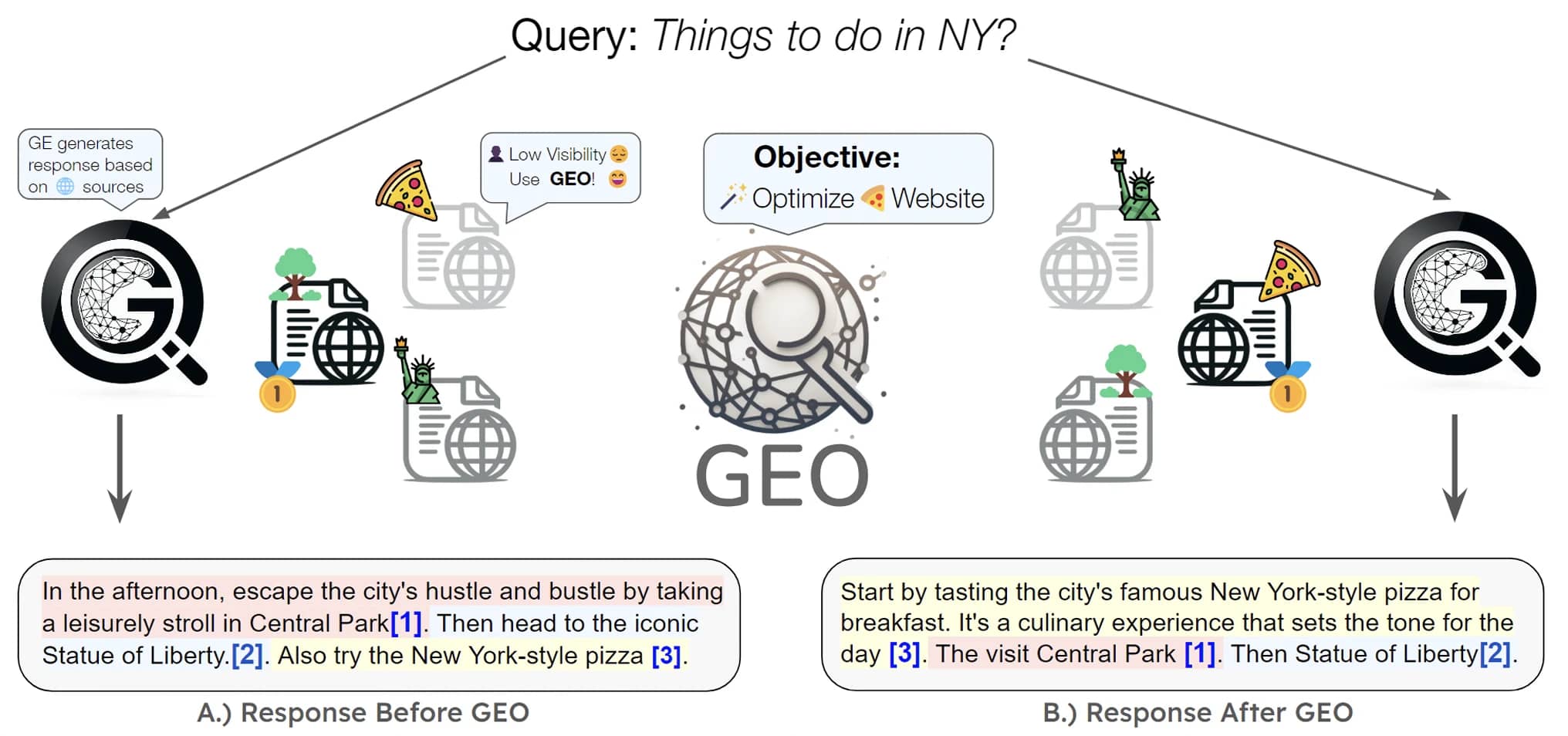
The diagram above illustrates how GEO transforms low-visibility content into prominently cited sources. Notice how the optimized pizza website (right) gains priority placement through strategic content structuring—the same "Things to do in NY" query now prominently features the pizza recommendation.
The Two-Front War
You're not optimizing for "AI"—you're fighting two distinct battles:
Front 1 - Real-Time Citability
- Where: ChatGPT Search, Perplexity
- How: Live web search via Bing
- Win with: Freshness, Bing indexing, clear structure
Front 2 - Brand Encoding
- Where: GPT-4o API, raw models
- How: No web access, only training data
- Win with: Unlinked brand mentions, PR, Wikipedia
Different battles, different strategies. Most fail by fighting only one.
Authority Signals That Matter
Three signals dominate GEO success:
1. Brand Web Mentions (Front 2)
Unlinked brand mentions correlate stronger with AI visibility than backlinks. LLMs are semantic—a sentence saying "According to [YourBrand] research..." is more powerful than a hyperlink.
2. Depth + Structure (Front 1)
Long, fact-dense pages that directly answer questions. Structure for extraction:
- Clear H2/H3 headings matching queries
- 30-50 word direct answers opening each section
- Bulleted lists and tables
- Explicit FAQ with Q&A pairs
3. SEO Fundamentals (Prerequisite)
You can't be cited if you can't be crawled. Bing indexing, sitemaps, site speed, schema markup—all table stakes.
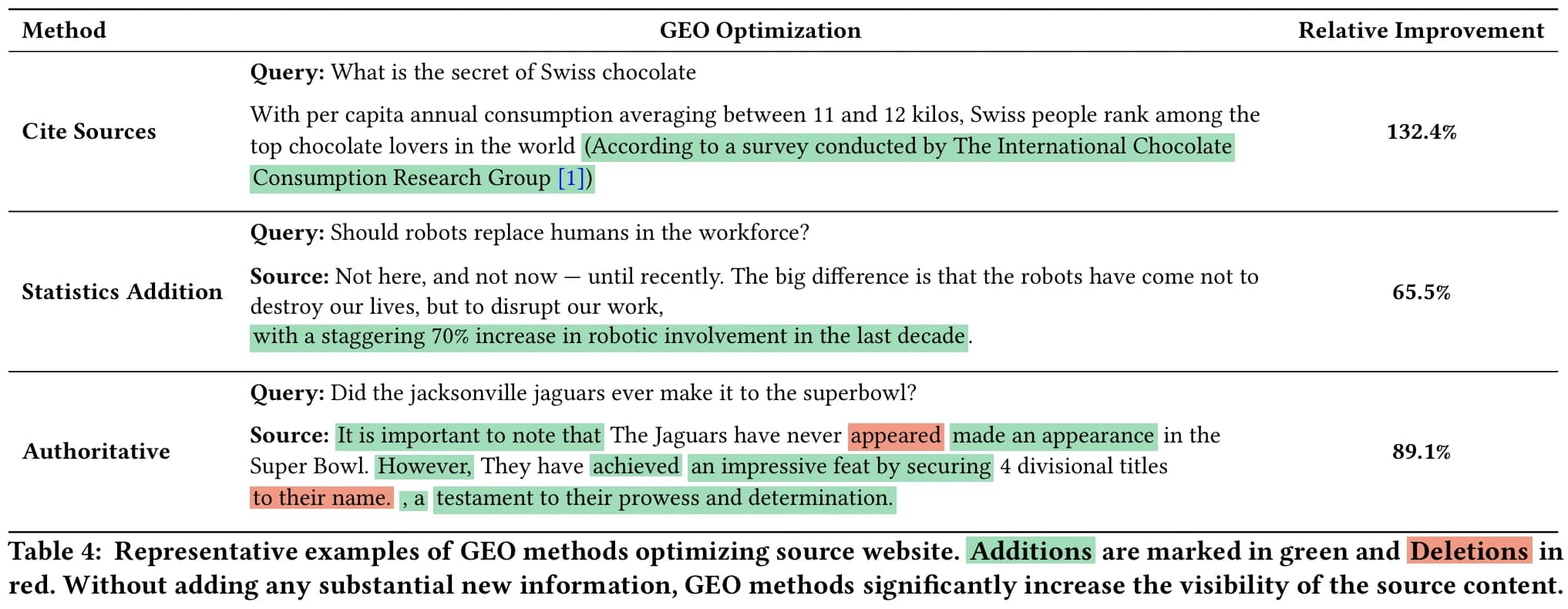
Research from Princeton, Georgia Tech, IIT Delhi, and Allen Institute shows these optimization methods deliver measurable results. The table above demonstrates how minimal content adjustments—adding citations, statistics, or authoritative language—can improve visibility by up to 132%.
Key takeaways from the research:
- Cite Sources: Adding credible citations (132.4% improvement)
- Statistics Addition: Including specific data points (65.5% improvement)
- Authoritative Language: Using confident, expert tone (89.1% improvement)
Your GEO Playbook
Content for AI Citation
- Fan-out research: Use ChatGPT to find related queries for your topic
- Build hub-and-spoke: One pillar page, multiple detail pages for sub-queries
- Write for extraction: Direct answer first, then context
- Create citable assets: Glossaries, benchmarks, datasets
Make Your Site AI-Legible
- Bing first: Verify in Bing Webmaster Tools, submit sitemaps
- Allow AI crawlers: Update robots.txt for GPTBot, ClaudeBot
- Add schema: FAQPage, HowTo, Organization markup
- Fast rendering: No client-side content gating
Build "Rememberability"
- Prioritize earned media: Focus on authoritative mentions
- Target training sources: Academic citations, Wikipedia, high-signal forums
- Create reference content: Be the source others cite
Platform Strategies
Measure What Matters
Stop obsessing over position. Track:
- Share of AI Voice: % of AI answers including your brand
- Citation Rate: How often and where you're cited
- Corpus Coverage: % of fan-out queries you own
- Freshness: Update cadence for data-sensitive content
Quick Implementation
Before (Old SEO)
Single blog post: "Best IPAs in Austin" targeting one keyword.
After (GEO Model)
Hub-and-spoke cluster:
- Hub: "Ultimate Austin Brewery Guide"
- Spoke 1: "Our IPA Lineup & Tasting Notes"
- Spoke 2: "Dog-Friendly Patio Hours"
- Spoke 3: "Taproom Events Schedule"
Submit to Bing, add FAQPage schema, allow GPTBot. When AI fan-outs, you're everywhere.
robots.txt Essentials
User-agent: GPTBot
Allow: /blog/
Allow: /docs/

User-agent: ClaudeBot
Allow: /blog/
Allow: /docs/

User-agent: Bingbot
Allow: /

Sitemap: https://yourdomain.com/sitemap.xml
Common Mistakes
- Ignoring Front 2: Focusing only on technical SEO, missing brand encoding
- Blocking AI crawlers: Misconfigured robots.txt = invisible to AI
- Single posts, not clusters: One-off content loses to comprehensive coverage
- Links over mentions: Chasing backlinks while competitors build brand mentions
- Narrative over answers: Long stories machines can't parse
FAQ
What's the difference between SEO and GEO? SEO ranks links. GEO gets citations inside AI answers.
Is SEO dead? No. It's the prerequisite. Can't be cited if not crawled.
How do I let AI crawlers in? robots.txt: Allow GPTBot, ClaudeBot. See example above.
Should I focus on Google or Bing? Both. Google for AI Overviews. Bing for ChatGPT Search.
By David Leer • Monday, October 27th 2025